
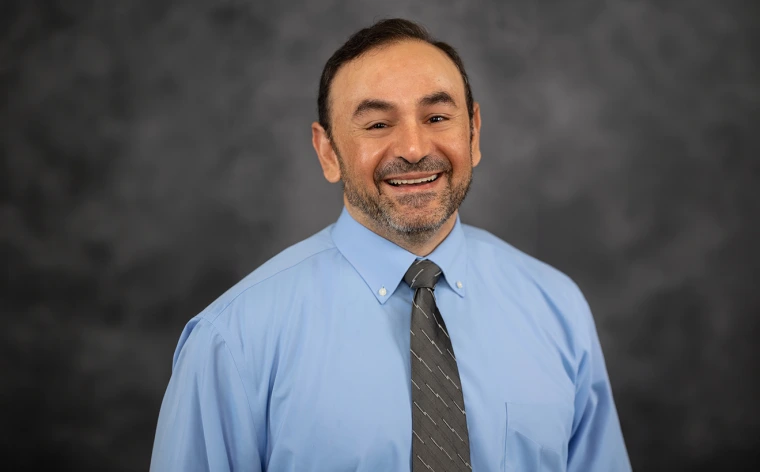
Youssef Roman, PharmD, Ph.D.
For Youssef Roman, PharmD, Ph.D., research has never been just about publications, grants or academic recognition.
Research is about people.
As a clinical translational scientist (a practitioner who bridges the gap between laboratory research and patient care), pharmacist, and associate professor of pharmacy practice and science at the University of Arizona R. Ken Coit College of Pharmacy, Roman has built his career around a question that is both straightforward and difficult: How can research help address the health challenges faced by people who have historically been underserved?
His answer begins with listening, continues with trust and, perhaps most importantly, requires bringing people together.
“My work has created a kind of positive feedback loop: knowing what I do can really make a difference,” Roman said. “Seeing the difference in the people that I work with, whether that is the community, individuals, or even my patients, it kind of created that positive reinforcement that what I do actually has a meaning and has a purpose.”
That sense of purpose has become a calling, and it has shaped a research journey that began in Idaho and is now expanding to Arizona.
According to a Contemporary Clinical Trials article, the underrepresentation of rural, underserved, and minority populations in clinical and medical research remains a persistent systemic issue.
“Despite making up roughly 40% of the U.S. population and bearing a disproportionate burden of chronic illnesses, racial and ethnic minorities are severely underrepresented in drug and therapeutic trials,” according to the Contemporary Clinical Trials article. “This gap is further compounded by a stark "geographic exclusion" for the 46 million Americans living in rural communities.”
Finding purpose in the work
Roman’s commitment to underserved and marginalized communities is personal.
As an immigrant who grew up in an underserved community, Roman experienced firsthand the challenges that can accompany limited access to resources and opportunities. Those experiences helped him understand the distance that can exist between people and the institutions designed to serve them.
It also shaped the populations he wanted to serve through his research.
“I think reflecting on my own journey as an individual allowed me to appreciate and feel connected with people who are further away from these big hubs and big institutions where you can do everything,” he said.
For Roman, that connection transformed research from an academic pursuit into something more meaningful.
He wanted research to help address real-world issues: access to care, participation in clinical research, health disparities and the ability to understand disease in ways that ultimately improve communication and care for patients.
The goal was not simply to study underserved communities, but to work with them.
That goal was the impetus behind creating the Community Advocacy and Research Empowerment (CARE) Coalition, which Roman launched while at Idaho State University with support from an ORAU Innovation Partnership Grant.
The IPG program strengthens connections between ORAU University Consortium members and collaborators by emphasizing research and education themes that align closely with ORAU’s expertise and strategic priorities. Youssef’s coalition, launched in 2025, is closely related to the work recently launched through ORAU’s Rural Health Research Innovation Cluster.
The idea was ambitious: bring together stakeholders invested in the health of rural, underserved and minority populations and create a structure where research and community advocacy could reinforce one another.
Roman sees the relationship between research and policy as inseparable.
“If we want to do research, if we want to change policies, we’ve got to do them hand-in-hand,” he said. “You can’t just change policy without data, and you cannot advocate without having data to support what you’re advocating for.”
The vision was clear: research could provide evidence for policy and systems change, community members could help identify the questions worth asking and, working together, the coalition could help translate knowledge into action.
Before any of that could happen, though, Roman needed to build something even more fundamental: relationships.
Starting with a cold call
When Roman began building the CARE Coalition, he was new to Idaho and had few existing connections, so he started calling people.
“I would just pick up the phone and talk to people,” he said. “It’s almost like speed dating.”
Roman introduced himself, explained what he hoped to accomplish and asked whether the people he was calling wanted to be part of it. He reached out to clinics serving underserved populations and to community leaders and organizations recommended by others.
Over time, those conversations became relationships. Those relationships became a network. And that network became the foundation of the CARE Coalition. Roman invited people representing different parts of the community to have a voice in determining what the coalition should become.
He didn’t come to his invited stakeholders with a finished research agenda. He wanted the group to build that agenda together.
Although Roman conceived the coalition, he emphasized that its future would be determined collaboratively.
“Togetherness was kind of really the key word there,” he said. “Can we bring everybody together and collectively make a decision so everybody knows what we’re doing, what the priorities are, what we’re going to do first, what we’re going to do last?”
That philosophy became the coalition’s operating model. Roman and his collaborators focused on creating governance for the CARE Coalition. They brought key stakeholders together to determine how the group would operate, how decisions would be made and how future projects would be prioritized.
The power of finding your people
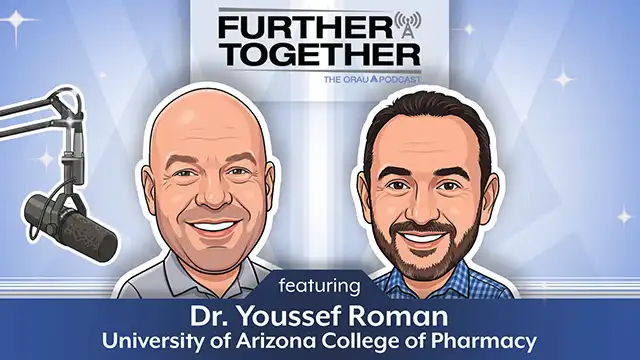
One of the most striking themes in Roman’s conversation with Further Together, The ORAU Podcast host Michael Holtz was the isolation that researchers and community advocates can sometimes feel.
People may be working on similar problems in different communities, states or institutions without ever knowing that someone else is asking the same questions. Then they meet, and something changes.
Holtz saw this in conversations with attendees of ORAU’s Rural Health Research Innovation Cluster workshop in July 2026, where researchers and other stakeholders from across the country came together to explore shared challenges and opportunities. Many thought they were the only researcher looking at their particular focus area until they met others at the workshop.
Roman knows that feeling.
“It is definitely easier to feel siloed and feel like you’re isolated,” he said. “But it’s absolutely amazing and it’s so refreshing and rejuvenating when you meet other colleagues who by chance are doing the same thing.”
Those connections provide more than collaboration opportunities. They provide validation. Finding someone else working on a similar problem can reassure a researcher that an idea isn’t as unusual or isolated as it might have seemed.
Meeting others opens the door to new research partnerships, comparisons across populations and opportunities to understand why an intervention works in one community but not another.
From Idaho to Arizona
Now at the University of Arizona, Roman says the lessons from Idaho have traveled with him, and he is working to develop a similar approach in Arizona, beginning with a closer look at the state’s unique health challenges and disparities.
Because of his experience building the CARE Coalition, Roman knows that community-building takes time, relationships must be cultivated and trust can’t be rushed. He also knows what is possible when those pieces come together.
Roman is now developing a grant focused on health, access and disparities in the Phoenix area and across Arizona, with an emphasis on addressing needs specific to the state and its communities.
The next chapter of CARE will be built on the lessons of the first.
The goal isn’t to simply replicate what worked in Idaho but to apply the lessons learned, listen to the new community and build something responsive to Arizona.