

March is Colorectal Cancer Awareness Month, an observance that promotes screening starting at age 45 to prevent colorectal cancer or catch cancer early.
I’m passionate about this issue. I’ve previously written about how I had the opportunity to write a white paper about ORAU’s history in the cancer space, and then even worked with a colleague on an ORAU-Directed Research and Development grant looking into the benefits of peer-to-peer support for men facing cancer.
The White House issued a statement in support of Colorectal Cancer Awareness Month that read: “We stand alongside every citizen courageously battling colon or rectal cancer, we pay tribute to those who lost their lives to the disease, and we renew our pledge to build a future that is healthy, strong, and totally cancer-free.”
This year, Colorectal Cancer Awareness Month arrives with a heightened sense of urgency. New data shows that colorectal cancer is the leading cause of cancer death for people under age 50.
The new data comes as a shock. As a 14-year survivor of stage-IIIB rectal cancer and a long-time advocate for an organization called Fight Colorectal Cancer, that single data point is a call to action to promote screening for prevention and early detection. Colorectal cancer is the only cancer that is completely preventable with screening and, if caught early, has a 90 to 95% survival rate.
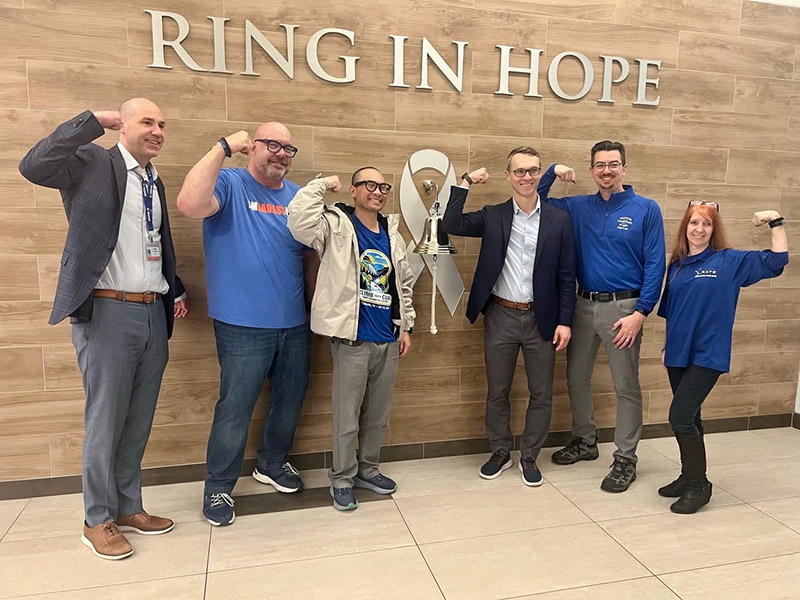
ORAU’s Michael Holtz (pictured second from the left) meets with Tim Cannon, MD., (pictured on far left) co-director of the gastrointestinal cancers program at Inova Shar Cancer Institute in Fairfax, Virginia, along with research advocates for Fight CRC and Rep. James Walkinshaw (pictured third from right).
Sadly, we’ve known colorectal cancer deaths were rising. For years we’ve been urging lawmakers to increase funding for research and early detection programs because projections told us colorectal cancer would be leading cause of cancer death for people under 50 by the year 2030.
Turns out, we actually crossed that threshold back in 2023, according to the American Cancer Society (ACS).
Alarming data on colorectal cancer
While that statistic is alarming on its own, there’s more.
- Colorectal cancer deaths are rising. Of the five leading cancers in the United States – lung, breast, prostate, colorectal and skin – only colorectal cancer has seen its death rates increase.
- Rectal cancer is on the leading edge of the rise in both colorectal cancer diagnoses and deaths. When we talk about colorectal cancer, we are talking about two parts the large intestine: the colon, which is about five-feet long and absorbs water and electrolytes as waste passes through; and the rectum, the last 6-8 inches, which acts as a storage reservoir until the waste can be eliminated.
- People born after 1990 have twice the risk of developing colon cancer than people born before 1990; they are at four times the risk of developing rectal cancer.
- Colorectal cancer incidence and mortality rates have been on the increase since 1950.
- 158,850 people will be diagnosed with colorectal cancer this year; 55,230 people will die of colon or rectal cancer.
Why is this happening?
Some research suggests the increase in colorectal cancer diagnosis and death is due to obesity and sedentary lifestyle. Other causes singled out in research include consumption of ultra processed foods, changes in the gut microbiome, environmental exposures and microplastics in the human body, according to the National Cancer Institute.
More research is needed to better pinpoint the causes and stop the rise in colorectal cancer diagnosis and death.
The state of colorectal cancer screening
When I was diagnosed in March 2012, age 50 was the recommended screening age for colorectal cancer. I was 43. Both the American Cancer Society and the United States Preventive Services Task Force lowered the recommended screening age to 45 in 2021. This is important because both ACS and the U.S. Preventative Services Task Force (USPSTF) screening guidelines are used for insurance coverage of colorectal cancer screenings.
Colonoscopy is the gold standard for colorectal cancer screening. During this 30- to 60-minute procedure, a flexible tube with a camera is inserted through the anus that allows a gastroenterologist to see, biopsy or remove polyps that may be found during the procedure. Patients are sedated, and preparation is required to clear the colon of any waste.
Stigma around the “back door entry” of a colonoscope and the preparation process keep some people from getting colonoscopies. I tell any audience that will listen that I would do the “prep” for a colonoscopy every day for the rest of my life to never hear the words, “you have cancer,” ever again.
For people who are hesitant to get a colonoscopy, there are other options, including fecal occult blood tests, fecal DNA tests like Cologuard, and circulating tumor DNA (ctDNA) blood tests, like Guardant Shield and New Day Diagnostics ColoHealth – all of which are non-invasive and may require a follow-up colonoscopy if tumor DNA is detected.
While the ctDNA blood tests are relatively new, fecal DNA tests have existed for more than 10 years, and fecal occult blood tests for far longer. Even so, more than 50% of people don’t know that there are colorectal cancer tests that can be done at home, according to the Colorectal Cancer Alliance 2026 State of Screening Study. Nearly 60% of people surveyed didn’t know a colonoscopy would be a necessary follow up step if there is a negative finding in any of the non-invasive tests.
Clearly, there is work to do in educating the public about the need for screening and the various methods of screening for colorectal cancer.
Don’t dismiss the symptoms
While colorectal cancer can have no symptoms in early stages, as the disease progresses symptoms may develop that include changes in bowel habits, blood in the stool, unexplained weight loss, unexplained abdominal cramping, strange-looking or strange-smelling stools. Additionally, feeling fatigued or anemic can also be signs of colorectal cancer.
As colorectal cancer rates continue to rise in people under age 50 – I know and have lost friends who were diagnosed in their 20s and 30s – it is important for younger people to talk to their doctors if they are experiencing any of the symptoms listed above.
Sadly, medical professionals often dismiss these symptoms in young people, especially young women, as hemorrhoids, irritable bowel syndrome or other illnesses. According to the Colorectal Cancer Alliance, 45% of adults under 45 say their symptoms were dismissed by their doctors.
What can you do?
While the latest colorectal cancer data are alarming, it’s important to know there are things we can all do to prevent colorectal cancer or catch it early.
Stay up to date on your screenings. Eat a healthy diet high in fiber. Exercise more. Know the symptoms and talk to your doctor if you are experiencing any of them.