

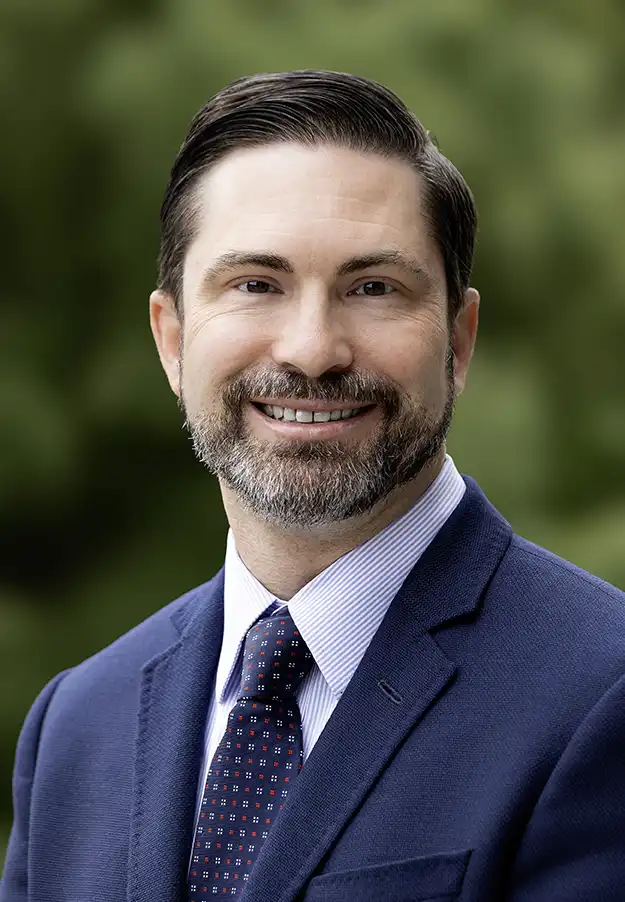
Greg Nichols, AI Lead for the ORAU STEM Accelerator (OSA)
As artificial intelligence continues to transform industries across the globe, its growing convergence with biotechnology is opening the door to both groundbreaking medical advances and complex new risks. Greg Nichols, AI Lead for the ORAU STEM Accelerator (OSA), has spent years examining those challenges through the lenses of public health, national defense and emerging technology policy.
While Nichols’ recent research and published work reflect his own scholarly interests and expertise, they also demonstrate the kind of forward- thinking that informs OSA’s broader mission of helping organizations responsibly and effectively navigate emerging technology needs. His work on AI and biotechnology is not a statement of OSA program direction, but rather an example of the depth of expertise and interdisciplinary analysis Nichols brings to conversations about innovation, risk and governance.
Nichols recently received a Thought Leadership Research Award focused on recommendations for governance and regulatory frameworks for overseeing the intersection of artificial intelligence and biotechnology. His work explores a central question facing researchers, policymakers and industry leaders alike: as these technologies evolve rapidly, where are the gaps in oversight?
In the past, Nichols worked within the Department of Defense, now the Department of War, in research and engineering, where he began studying emerging technologies from a risk perspective. That experience, combined with his background in public health and even philosophy, positioned him to contribute a chapter in a textbook examining the convergence of AI and biotechnology in a broader discussion of technology governance and security.
“Artificial intelligence is basically the discipline, the science that deals with developing non-human consciousness, non-human logical structures and ways of thinking and ways of emulating what the human mind does but in a machine form,” Nichols explained. “And then biotechnology is the use of engineering and scientific tools and methods to recreate biological systems, manipulate biological systems, to have different types of structures and functions.”
The potential benefits of combining those disciplines are significant. Nichols points to advances in pharmaceutical sciences, genetic engineering and disease treatment as areas where AI could dramatically accelerate scientific discovery.
“One thing about AI that I think is really helpful is it can go through millions and millions of iterations of things that we can't do as humans,” he said. “It would take us thousands of years to do some of these things.”
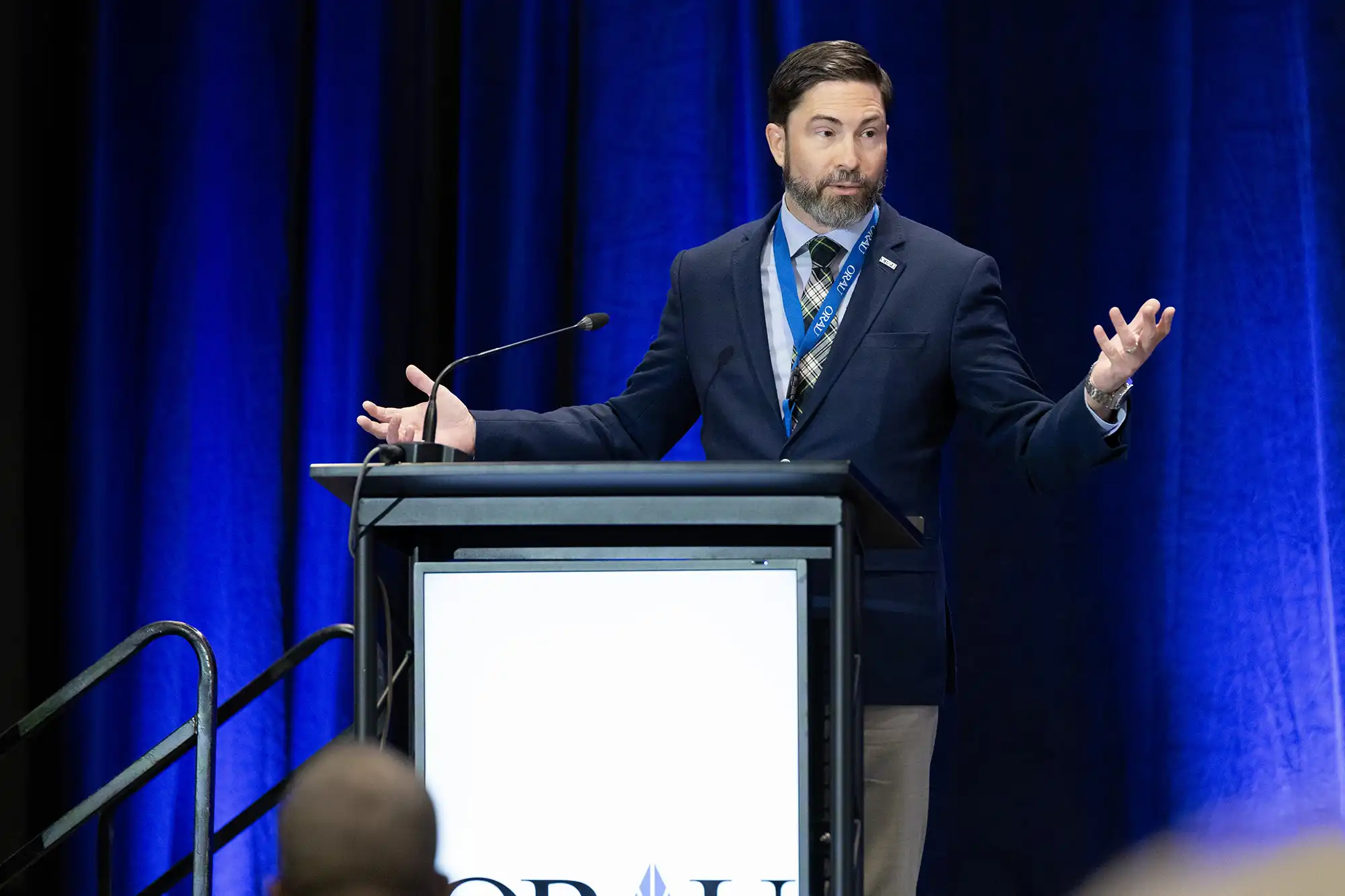
ORAU’s Greg Nichols presents during company’s annual meeting.
He referenced initiatives such as the Department of Energy’s Genesis Mission, which uses massive scientific datasets to explore many areas including new possibilities in pharmaceutical research and early detection of biological threats. AI systems can analyze vast amounts of biological and medical information to identify promising compounds, model disease treatments and potentially uncover therapies for conditions that have historically been difficult—or impossible—to treat.
At the same time, Nichols emphasizes that these same capabilities introduce serious concerns.
“A lot of these technologies are what we refer to as dual-use because they can have really good applications,” he said. “But there's also a lot of horrible, terrible things that can happen.”
Those concerns range from the intentional misuse of biotechnology, such as the development of bioweapons or more virulent pathogens, to accidental consequences from systems researchers do not yet fully understand. Nichols referenced a familiar cultural example to illustrate the point.
“One of my favorite quotes of all time is from the original Jurassic Park,” he said. “‘Your scientists were so preoccupied with whether or not they could, they didn't stop to think if they should.’”
Nichols also points to a longstanding ORAU connection to the broader ethical questions surrounding science and society. He cites former ORAU Institute for Energy Analysis Director Dr. Alvin Weinberg, who once observed:
“Many of the issues which arise in the course of the interaction between science or technology and society – e.g., the deleterious side effects of technology, or the attempts to deal with social problems through the procedures of science – hang on the answers to questions which can be asked of science and yet which cannot be answered by science.”
For Nichols, that tension underscores why technological advancement must be paired with thoughtful governance and interdisciplinary collaboration.
“Obviously in the beginning, we don't know exactly what's going to happen,” he said, “so that's why there should be some caution and understanding. At least put some guardrails on it until we're more sure of what we can do with this technology.”
Finding the right balance is critical. Moving too quickly can create unnecessary risks, but excessive resistance can also slow meaningful progress in medicine and public health.
Nichols notes that society has navigated similar moments before. He points to the evolution of nuclear science—from the Manhattan Project to today’s commercial nuclear energy industry—as an example of how regulation and innovation can mature together.
“We've been through this before,” he said. “It’s very possible to develop the guardrails and the frameworks and things that you need in order to safely develop and implement these technologies. So, I think that's a big takeaway. This is a challenge, but it is solvable.”
As AI and biotechnology continue to reshape the future of medicine, security, and scientific research, Nichols believes thoughtful governance will be essential to ensuring those advancements benefit society while minimizing unintended consequences.
To read Nichols’ chapter, visit: https://link.springer.com/chapter/10.1007/978-3-032-05246-9_8 (subscription required).