
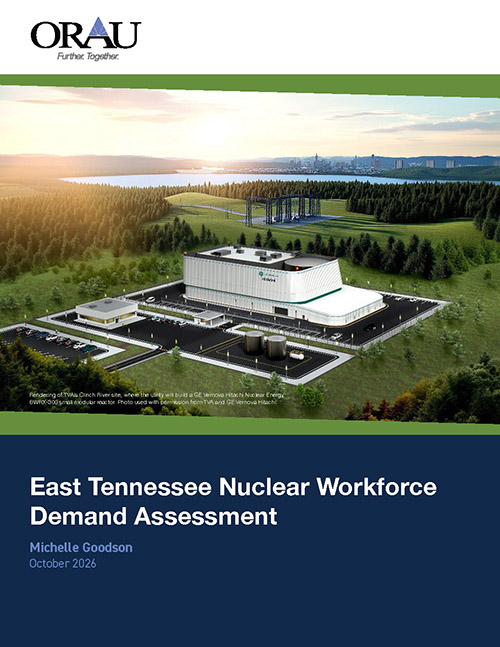
Download the report (.PDF)
Demand for some categories of nuclear energy workers outpaces Tennessee’s current training pipelines, according to the East Tennessee Nuclear Workforce Demand Assessment, released by ORAU on October 8, 2026.
According to the assessment, demand for chemical plant and systems operators, nuclear reactor operators, production and operations supervisors, and power plant operators outpaces existing education and training pipelines. Among the companies surveyed, Tennessee's nuclear workforce totals approximately 17,000 workers today and is projected to reach a peak of approximately 21,000 workers by 2032, a compound annual growth rate of roughly 3.4%.
“This growth is driven by an ecosystem of multiple new nuclear projects rather than a single construction cycle,” said Michelle Goodson, ORAU senior director of strategic growth and partnerships and author of the demand assessment. “Operations-related demand is expected to climb steadily through 2035, while construction-related demand peaks in 2032 before easing.”
The demand for workers is the result of a historic expansion of East Tennessee's nuclear industry, where private sector companies have pledged more than $10 billion to nuclear buildouts in the region. As this investment accelerates, ensuring an adequate supply of skilled workers has become a central concern for the companies investing in the region and the government agencies that support them.
“By quantifying nuclear workforce demand as this report does, ORAU hopes to increase investor and community confidence in the nuclear industry and to strengthen the work of stakeholders already collaborating to meet growing demand for a skilled nuclear workforce.,” said Meghan Millwood, ORAU President and CEO. “As investment in Tennessee’s nuclear industry accelerates, ensuring an adequate supply of skilled workers has become a central concern for the companies driving it and the state agencies supporting them. Access to a qualified workforce is a major factor in determining where a company chooses to locate new operations.”
ORAU’s assessment attempts to respond to concerns expressed across industry and government about whether the current workforce development ecosystem is sufficient to support all the stated announcements for new nuclear investment. Quantifying workforce demand and identifying expected training gaps in specific roles can help Tennessee target the highest impact nuclear supply chain investment opportunities in workforce development. This kind of targeted investment can lead to a more qualified nuclear workforce, attracting further private sector capital into the state.
“This study underscores a critical reality: the timeline for deploying advanced nuclear technologies is fundamentally tethered to the velocity of our talent pipeline,” said Bill Tindal, director of the Tennessee Nuclear Network, the state’s official partnership advancing nuclear innovation, workforce development, and economic growth. “To capitalize on this projected growth, we must use this data to precisely scale our investments in skilled trades, technical training, and professional development across East Tennessee.”
To develop the East Tennessee Nuclear Workforce Demand Assessment, ORAU conducted structured interviews with 14 companies across the Tennessee Nuclear Network. These companies, all engaged in Oak Ridge's nuclear expansion, were interviewed over a three-month period, supplemented by a quantitative needs-assessment matrix and a preliminary review of publicly available workforce supply data.
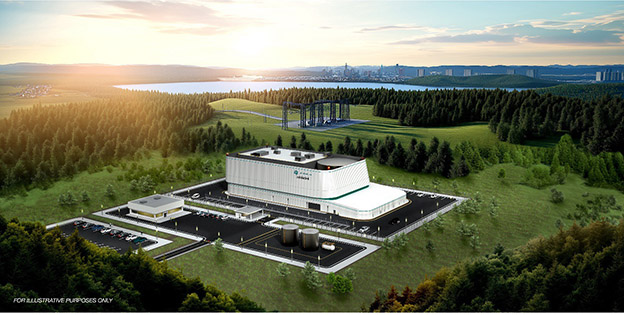
Rendering of TVA’s Clinch River site, where the utility will build a GE Vernova Hitachi Nuclear Energy BWRX-300 small modular reactor. Photo used with permission from TVA and GE Vernova Hitachi.
Workforce recommendations
To meet existing and future workforce demand, assessment authors make four recommendations:
- Strengthen Tennessee Nuclear Fund's data-based portfolio management strategy to direct workforce investment where it is needed most
- Expand this workforce demand assessment to include a broader and more diverse set of employers
- Conduct a full, statewide workforce supply study with regional detail to update and validate this report's supply-side findings
- Invest in training capacity for the occupations identified as most at risk of a shortfall.
Goodson said the assessment’s findings are a snapshot of the state’s nuclear workforce landscape based on data from the 14 companies interviewed for the study and are intended to support ongoing collaboration among industry, education, workforce development and public-sector partners to address emerging workforce needs.
“New investment announcements continue to be made regularly, and this report likely underestimates the state's ultimate nuclear workforce needs. This assessment is best understood as the first step in understanding Tennessee's nuclear workforce needs,” she said.
While the initial employer sample represents only a portion of the nuclear companies growing across East Tennessee, it provides an important view of where workforce pressure is likely to emerge and establishes a foundation for deeper, employer-informed analysis. The next phase should broaden employer participation and continue to connect projected labor demand with the training, career exploration, and workforce investments needed to meet it.
Ongoing workforce demand efforts
The East Tennessee Nuclear Workforce Demand Assessment is the latest in ORAU’s ongoing work to understand and help meet the needs of the burgeoning nuclear energy workforce in the Oak Ridge area and beyond.
In May, ORAU convened the first-ever Pathway to Trades Summit in Oak Ridge, Tenn., to help meet the need for skilled trades workers in Oak Ridge. The Pathway to Trades Summit was hosted by ORAU in collaboration with the North America’s Building Trades Unions and the Tennessee Nuclear Network.
Pathway to Trades brought together leaders from labor organizations, industry, government, education and community support services for a day of conversations and collaboration to identify priorities and take steps to address the need to build a skilled workforce capable of meeting the rapidly growing demands of the nuclear sector.
Key takeaways and next steps from the summit can be found on a specially created Pathway to Trades Results page. The recommended next steps from the summit are in the same format as the NEAR recommendations, enabling them to be integrated seamlessly where appropriate.
A follow-up event, called Next Steps for the Nuclear Workforce, will feature a keynote address by James P. Danly, Deputy Secretary of Education, and remarks from Congressman Chuck Fleischmann, whose district includes Oak Ridge. The event is set for 12:30 p.m. on Tuesday, Oct. 20, 2026, at Pollard Center on ORAU’s main campus.
The Nuclear Energy Academic Roadmap (NEAR), released in September 2025, was created to address the critical need for skilled nuclear energy workforce.
Developed as a collaborative effort of the Partnership for Nuclear Energy, an ORAU-led nationwide public-private partnership, NEAR brings together universities, community colleges, technical training organizations, nuclear industry companies, professional organizations, national laboratories and government agencies to create a blueprint for strengthening nuclear education and workforce development.
The NEAR was developed through the contributions of people across academia, industry and government. ORAU supported the effort, but the expertise came from the people around the table—and many of those people continue to volunteer their time to advance the work.
“There is no single organization that can build the nuclear workforce the country will need over the next several decades,” Goodson said. “It will take educators, employers, government agencies, universities, community colleges, technical training organizations, national laboratories, industry associations and communities working together to meet this critical need.”