
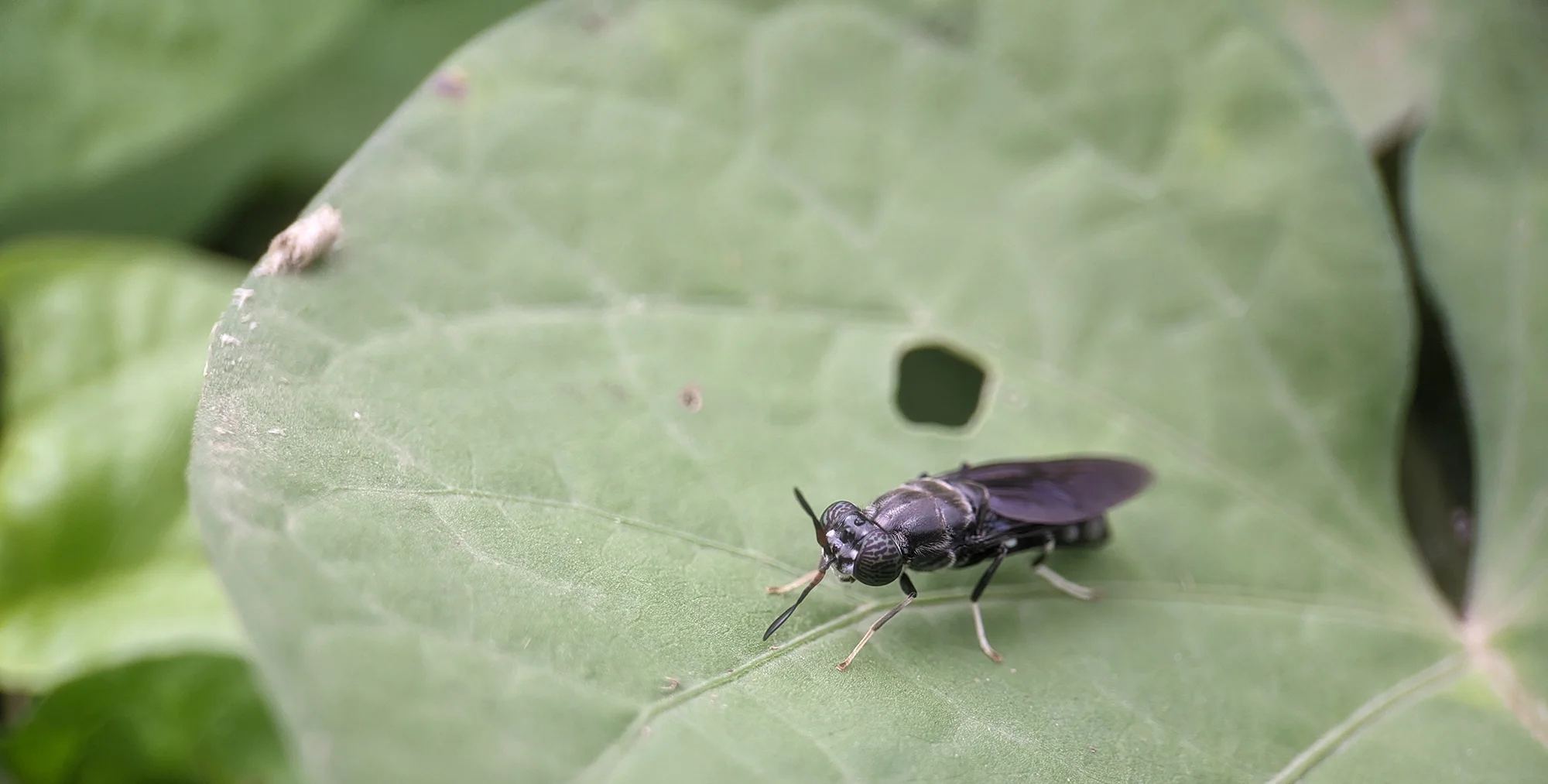
When most people think about flies, they probably think about pests, especially during the summer months. But the black soldier fly is different.
In fact, researchers believe this unassuming insect could play a major role in addressing some of the world’s biggest challenges – from waste management and sustainable agriculture to human health and even future space exploration.
Through an ORAU-Directed Research and Development (ODRD) grant awarded in 2025, Patrick Cosme, Ph.D, ORAU research associate and Holly Holt, Ph.D., former ORAU research specialist collaborated with Charity Owings, Ph.D., Research Assistant Professor in the Department of Entomology and Plant Biology at the University of Tennessee and Jeff Tomberlin, Ph.D., Professor and Agrilife Research Fellow in the Department of Entomology at Texas A&M University and one of the world’s leading experts on black soldier flies, to better understand how these insects can contribute to a more sustainable future.
Holt and Tomberlin discussed their project on an episode of Further Together, The ORAU Podcast.
Their research combined laboratory science, environmental sustainability and social science research to answer a deceptively simple question: What else can black soldier flies do?
Nature’s Ultimate Recyclers
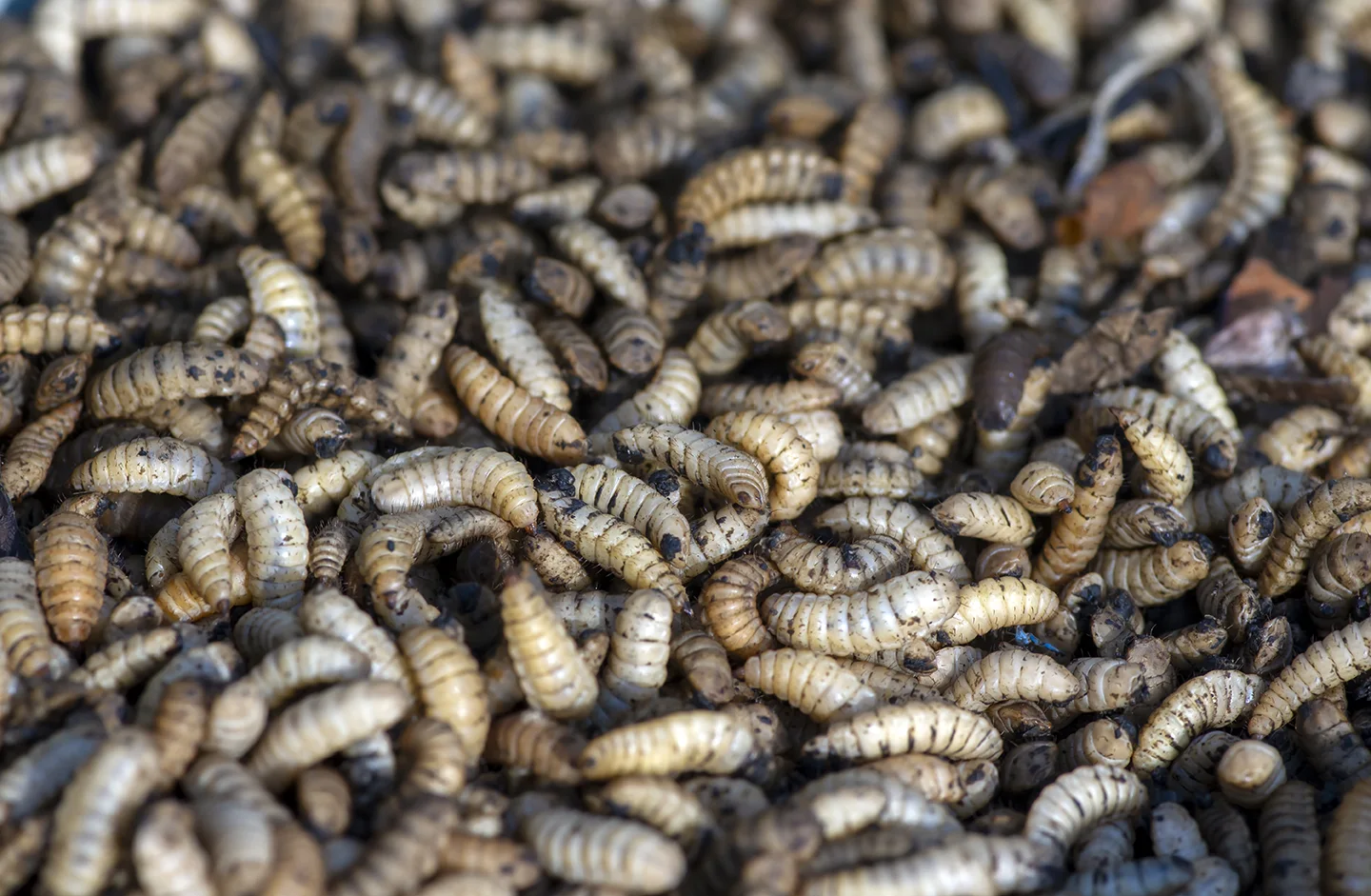
Black soldier larvae
Native to the southern United States, Central America and South America, black soldier flies aren’t considered pests. In fact, adult black soldier flies don’t bite or spread disease. They resemble wasps as a form of mimicry and spend their short adult lives focused almost entirely on reproduction.
The real stars of the story are their larvae.
“What makes them so exceptional is that their larvae can eat practically anything organic,” said Tomberlin.
Black soldier fly larvae can rapidly convert food scraps, agricultural waste and other organic materials into valuable biomass. That biomass can then be processed into ingredients for animal feed, while the remaining material – known as frass – can be used as a natural fertilizer.
The result is a powerful example of a circular economy: waste becomes a resource rather than ending up in a landfill.
Even more impressive, black soldier fly operations already exist around the world. Some people raise them in backyard compost systems, while industrial facilities process hundreds of tons of organic waste every day.
Looking Beyond Feed and Fertilizer
While black soldier flies are already being used in animal feed and agricultural applications, Holt’s research focuses on what may come next.
Scientists have discovered that black soldier flies contain a variety of compounds and materials with potential uses across multiple industries.
One of the most promising compounds is chitin, a natural material found in the insect’s exoskeleton. Chitin and related compounds have antimicrobial properties and can bind to contaminants such as heavy metals. Uses for chitin include a wide range of potential applications, like:
- Medical products and wound care materials
- Cosmetic ingredients
- Food preservation technologies
- Environmental cleanup and bioremediation
- Water filtration systems
Researchers are also investigating the nutrient potential of black soldier flies, which can support human health as good sources of calcium, omega-3 fatty acids, choline and nutrients.
“There are a lot of materials within the insect that we think can be harvested and used as supplements to address global health challenges,” Tomberlin said.
Using Data to Identify Emerging Opportunities
To understand where black soldier fly research is heading, Holt conducted an extensive review of scientific literature spanning more than four decades. Using machine learning tools, she analyzed hundreds of publications to identify patterns, emerging themes, and areas of growing interest.
The results revealed established research areas such as livestock feed and nutrition, while also highlighting newer opportunities related to biomaterials, sustainability, environmental remediation, and circular economies. This analysis sets the stage for creating a roadmap of where innovation is occurring and where future investment and collaboration may have the greatest impact.
“Connecting trends observed in the literature with current and upcoming processes in the real world is a logical next step,” Cosme said.
The next phase of the project involves interviews with researchers and industry leaders to better understand which emerging applications may have the greatest potential for adoption and commercialization.
A Question of Public Acceptance
Scientific breakthroughs alone are rarely enough to transform industries. Public perception matters too. One of the unique aspects of the research team’s project is its focus on understanding how people feel about insect-based technologies and products.
Using social listening tools, Holt explored online conversations about black soldier flies across social media platforms, discussion forums and hobbyist communities.
Some findings were expected. Enthusiasts, like backyard chicken owners and composters, have already embraced black soldier flies. Other findings revealed challenges, including misinformation and misconceptions about insects and insect-derived products.
Tomberlin believes public education will be critical to broader adoption.
“If you want to see paradigm shifts, work with younger generations,” he said.
He envisions future educational programs that introduce students to black soldier flies through schools, 4-H programs, Future Farmers of America chapters and community colleges, helping build familiarity with sustainable agricultural technologies from an early age.
Understanding Insect Health
Alongside the social science research, Owings is conducting groundbreaking laboratory studies examining how black soldier fly larvae respond to environmental stressors. Her research explores how the confluence of real-world factors such as heavy metals and other environmental conditions affect larval growth, development, nutrition, and overall health.
The project measures everything from gene expression and nutrient composition to survival rates and gut health.
Researchers are also investigating whether stressed larvae produce distinctive odors that could serve as early warning indicators in commercial production systems.
If successful, these discoveries could help producers identify problems before they impact large populations of insects, improving both animal welfare and operational efficiency.
The work represents the first black soldier fly research project of its kind conducted in Tennessee, creating valuable knowledge for both the state and the broader scientific community.
From Earth to Mars
Perhaps the most fascinating aspect of the project is how far its implications may extend.
As scientists and engineers consider long-duration space missions and future habitats on the Moon or Mars, sustainable systems for managing waste and producing food become increasingly important.
Black soldier flies could become part of those systems.
By converting organic waste into usable nutrients while supporting plant growth and food production, they may help create the kind of closed-loop ecosystems necessary for human life beyond Earth.
“If we can solve problems here on Earth today,” Tomberlin said, “who knows where those solutions can be in the future?”
Just Getting Started
What began as a conversation among researchers with different areas of expertise has evolved into a multidisciplinary effort with global implications.
The project demonstrates the power of collaboration between ORAU, the University of Tennessee, Texas A&M University, and experts across scientific disciplines. It also highlights how innovative research often starts with curiosity about an insect hiding in a compost pile.
The researchers are careful not to overstate the black soldier fly’s potential. It’s not quite Superman –not yet anyway.
But with applications ranging from sustainable agriculture and environmental remediation to human health and space exploration, the black soldier fly may prove to be one of nature’s most valuable, if highly underappreciated, allies.
Cosme noted, “Once they start learning about black soldier flies, people always want to know more.”